Lighting a Spring-Fed Garden Pond for Evening Ambience: Inspiring Ideas
October 30, 2026 - Inspiration

October 29, 2026 - Design

October 28, 2026 - Sources
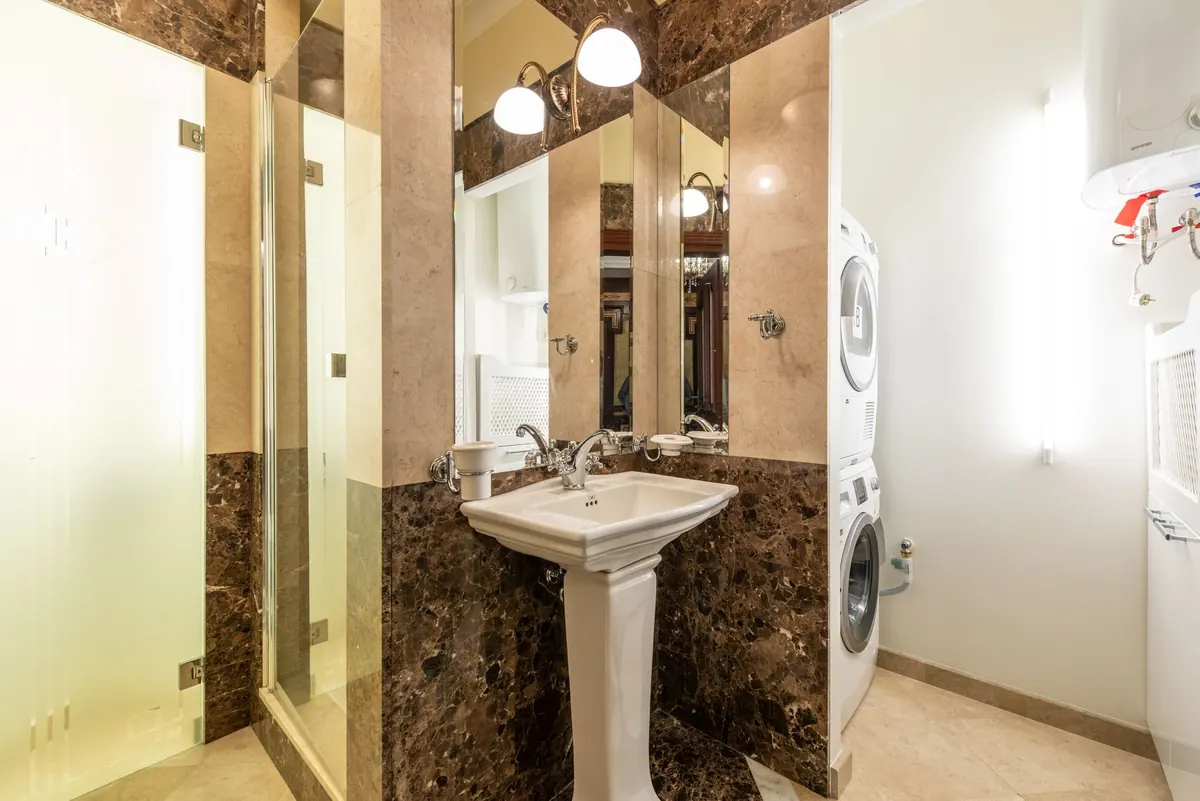
A windowless bathroom has one quiet advantage: you control every bit of light in it. No glare from a south-facing window, no guessing at the weather, no dull afternoons. And yet these are exactly the rooms where lighting most often goes wrong, because there is no daylight to cover for a bad decision. One ceiling fitting goes in, the switch goes on, and the result is a room that manages to be glaring and gloomy at the same time: bright on the top of your head, dim at the mirror, harsh on white tiles, flat on skin. None of that is a question of buying more light. It is a question of where the light comes from.
A small bathroom tempts you into one big gesture. A bright fitting in the middle of the ceiling, switched on at the door, looks efficient on paper. In practice it lights the floor, the top of your head and the far wall, while leaving the surfaces you actually use in shadow. Almost everything that happens in a bathroom happens at arm's length from a mirror, a shelf or a tap.
Think in layers instead. You want a soft ambient layer so the room does not feel like a cupboard, a task layer at the mirror, and one low light for the middle of the night. In a three- or four-square-metre room that is two or three fittings, not eight. What matters is that each one has a job and that you can switch them separately, so the mirror can be bright while the rest of the room stays calm.
In a large room, a bare lamp is a minor annoyance. In a windowless bathroom it becomes the whole experience, because the fitting sits close to your eyes and there is nothing else to look at. The usual culprits are exposed LED lamps, decorative bulbs above a mirror, and recessed downlights aimed straight onto glossy tiles or into the mirror itself. You end up squinting while you shave, and a bright disc follows you around the room in the reflection.
A single strip above the mirror is the most common mistake in bathroom lighting, and the most disappointing. It lights your forehead and the top of your nose beautifully, then drops a shadow under your brows and another under your chin. A backlit mirror has the opposite problem: the glow behind the glass turns your face into a silhouette. Both look fine in a photograph and are useless for shaving, plucking, flossing or checking whether that spot is as red as it feels.
Light wants to come from the sides. Two fittings at roughly face height, one on each side of the mirror, spread light evenly across the face and soften the lines under the eyes. Where wall space is tight, slim vertical bars work well; where there is room for only one fitting, a mirror with integral light down both edges is a better investment than a brighter lamp above it. If you want to test the idea before committing, stand at the basin one evening with a phone torch held to each side of your face, then try one above your head. The difference is obvious within seconds.
Whatever lights the mirror will also light the tiles beside it, so keep the spacing balanced. Fittings pushed tight into a corner throw a bright patch on one side of your face and nothing on the other. If the basin sits off-centre, centre the lights on the mirror, not on the wall.
Colour temperature is where small bathrooms quietly come apart. A cool white ceiling light and a warm lamp above the mirror produce two different versions of white on the same tiles, and a face that looks grey in the mirror and yellow in daylight. It is a common combination, usually put together by accident, and it never looks intentional.
Pick one family and stay in it. Around 3000K — warm white, slightly on the neutral side — suits most bathrooms: friendly in the evening, clear enough for a morning shave. Some people prefer 2700K for a softer, more hotel-like feel, and 4000K for a crisper, more clinical look. All three work; mixing them does not.
The mirror is the one place to be fussy. Look for a high colour rendering index, ideally 90 or above, so skin tones, make-up and the colour of a shirt read the way they will outdoors. A cheap lamp with a low rendering index will make a red lipstick look brown and a grey jumper look green, and you will only notice once you are out of the door.
A windowless bathroom is a wet room by default. Steam has nowhere to escape except through the extractor fan, and it condenses on every cool surface, including light fittings. Open decorative pendants, fabric shades and anything with a loose connection are poor choices, however good they look in the shop.
Fittings in the splash zones need a suitable IP rating, and the zones themselves are defined by distance from the bath or shower tray rather than by where the water usually lands. The exact requirements and the permitted ratings differ between countries, and they are not a subject for guesswork. Treat the guidance as orientation, confirm what applies where you live, and have any new circuit or fitting inside a wet zone installed and checked by a qualified electrician. This is one of the few areas of home improvement where the paperwork genuinely protects you.
Two practical details are easy to forget. First, LED fittings still have drivers, and drivers fail; keep them somewhere accessible rather than sealed behind tiles. Second, a sealed, gasketed fitting with a glass or polycarbonate diffuser will shrug off steam for years, while an unsealed one will collect a film of condensation and dust that dims it within a season.
Once a small room is properly lit, the temptation is to add more. Resist it. Four bright downlights in a four-square-metre bathroom feel like a changing room at full power, and there is nowhere to look that is not bright. Contrast is what makes a room comfortable: a gentle ambient level, a brighter pool at the mirror, a soft glow near the floor at 3 a.m.
Dimming helps, if you buy a dimmable driver and a compatible dimmer — mismatched dimmers are a frequent cause of flicker and buzz. Separate switching is cheaper and just as useful: one switch for the ambient light, one for the mirror. And put a low-level light on a separate circuit or a sensor near the door, so a night-time visit does not require flooding the room with white light and waking yourself up properly.
Start with the person, then the room, then the wiring. In practice that means deciding the mirror position and the two task lights first, and letting everything else follow.
Do that and a windowless bathroom stops being a compromise. It becomes the one room in the house where the light does exactly what you ask of it.
Photo: Max Vakhtbovych / Pexels

A practical, low-glare guide to lighting a spring-fed pond after dark: where to place fixtures, how to catch moving...
A practical layout guide for building a reading corner around a swing-arm wall lamp, from chair placement and lamp...
October 29, 2026 - Design
October 28, 2026 - Sources
Copyright © 2026 Fari Della Sorgente. All Right Reserved.